Could Ancient Kabbalah Explain What Ghost Hunters Are Capturing?
Every year, paranormal investigators return from haunted locations with thousands of photographs, EVPs, thermal anomalies, EMF spikes, and SLS camera images. The obvious question is: Are all of these pieces of evidence showing the same type of spirit, or could they be detecting different aspects of consciousness?
One ancient mystical tradition offers an intriguing way to think about that question.
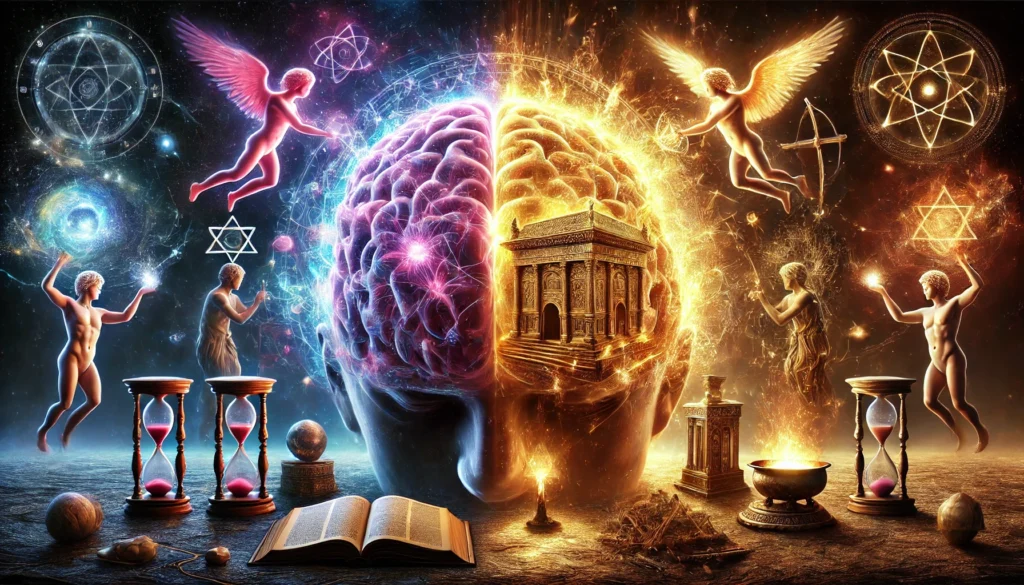
Kabbalah, the Jewish mystical tradition, describes human consciousness as existing in multiple levels rather than as a single, unified soul. According to its teachings, each level of consciousness requires its own spiritual “vessel” or body through which it can function.[ Kabbalists summarize this principle with a simple idea: there is no light without a vessel. Consciousness cannot express itself unless it has a form.]
While Kabbalah was never written as a guide for ghost hunters, its model raises an interesting possibility. Perhaps paranormal investigators are not detecting one generic “ghost.” Instead, different investigative tools may be interacting with different layers of what once made up a human being.
A Multi-Layered Human Being
Kabbalah describes five primary levels of the soul.
Nefesh– is the life force connected to the physical body. It governs instinct, survival, and our connection to the material world.
Ruach– is the emotional and personal self. It contains memory, personality, speech, and feeling.
Neshamah – represents higher intellect and spiritual understanding.
Above these are Chayah, associated with transcendent awareness, and Yechidah, representing complete unity with the Divine.
Rather than viewing these as separate souls, Kabbalah sees them as different expressions of one consciousness operating through different spiritual bodies or garments.
Consciousness Needs a Vehicle
Imagine an astronaut leaving Earth. The astronaut needs one type of suit for space, another vehicle to travel through the atmosphere, and another environment to live safely on Earth.
Kabbalah applies the same principle to consciousness.
The physical body allows us to function in the material world. The emotional body allows consciousness to experience emotion. Higher spiritual bodies allow consciousness to perceive realities beyond ordinary human awareness.
Each level is a vehicle designed for a different environment.
If that model is correct, then death may not simply be the disappearance of consciousness. Instead, it could involve different layers separating from the physical body at different stages.
Looking at Paranormal Evidence Through a Kabbalistic Lens
This is where things become especially interesting for paranormal investigators.
Many investigators assume every unexplained event comes from the same source. Kabbalah suggests otherwise.
Cold Spots and EMF Activity
The Nefesh is the aspect most closely connected to the physical body. Some Kabbalistic writings describe it as lingering near the body or locations strongly connected to a person’s life.
If that is true, then temperature drops, unusual electromagnetic readings, or residual hauntings might represent interactions with this denser layer of spiritual energy rather than an intelligent spirit.
EVPs and Spirit Box Communication
The Ruach contains personality, memory, and speech.
If fragments or echoes of the Ruach remain connected to a location, they could explain why investigators sometimes capture voices, names, emotional responses, or intelligent answers during EVP sessions and spirit box experiments.
Instead of recording random energy, investigators may be detecting the communicative aspect of consciousness.
SLS Cameras and Human-Shaped Apparitions
Kabbalah also speaks of the Tzelem, often described as a spiritual blueprint or pattern that mirrors the human form.
When SLS cameras map a stick figure where no visible person exists, investigators usually debate whether the device is malfunctioning or detecting something unseen.
From a Kabbalistic perspective, one could ask a different question.
Could the camera be identifying the structural pattern of a spiritual body rather than a fully conscious spirit?
While this remains speculative, it offers a fascinating framework for interpreting some visual anomalies.
Different Frequencies, Different Bodies
One of the most interesting implications of Kabbalah is that each level of consciousness operates at its own degree of subtlety.
If different spiritual bodies exist, then they may interact with the physical world in different ways.
A thermal camera may respond to one layer.
An EMF meter may respond to another.
A digital recorder may capture yet another.
Rather than expecting every device to detect the same phenomenon, investigators might consider whether each instrument is sensitive to different expressions of consciousness.
A New Way to Think About Ghost Hunting
This idea does not prove the existence of ghosts, nor does it prove that paranormal equipment detects spiritual bodies. Scientific evidence for these claims remains limited and controversial.
However, Kabbalah provides a remarkably detailed model of layered consciousness that invites an interesting comparison with modern paranormal investigation.
Perhaps investigators are not searching for “ghosts” at all.
Perhaps they are observing different levels of consciousness interacting with the physical world through different spiritual vehicles.
Whether one accepts Kabbalah as theology, philosophy, or symbolic psychology, it offers a compelling framework for asking better questions about the evidence collected in haunted locations.
The next time an investigator captures an unexplained EVP, records an EMF spike, or watches an SLS camera map an invisible human figure, it may be worth considering that these events are not necessarily connected to one single phenomenon.
They may instead be glimpses of different layers of consciousness—layers that an ancient mystical tradition attempted to describe centuries before the invention of modern paranormal equipment.
For ghost hunters, that possibility may be one of the most fascinating investigations of all.
With what we know about the Kabbalah and if you’re using Kabbalah as an inspirational framework rather than assuming it’s literally describing ghosts, it suggests a different style of questioning than investigators typically use. Instead of asking for proof (“Knock once if you’re here”), you would ask questions that engage memory, identity, emotion, or awareness—the qualities Kabbalah associates with different levels of the soul.
For example:
Questions about identity (Ruach – personality and memory)
“How do you identify yourself?”
“Do you remember your name?”
“How do you remember your life?”
“What is the strongest memory you still carry?”
“Do you know where you are now?”
Questions about awareness
“Can you perceive us as clearly as we perceive this room?”
“What does this place look like from your perspective?”
“Do you experience time the way we do?”
“Can you see everyone in this room?”
Questions about emotion
“Why have you remained connected to this place?”
“Is there something unfinished that keeps your attention here?”
“What emotion is strongest for you right now?”
“Is there anything you want people to understand?”
Questions about consciousness
“Has your awareness changed since your physical life ended?”
“Can consciousness exist without a physical body?”
“Do you experience learning or growth where you are?”
“Can you choose when to communicate?”
Questions about perception
“What allows you to notice us?”
“Can you see the lights or equipment we’re using?”
“Does any particular device make it easier for you to communicate?”
“What makes communication difficult?”
A Kabbalistic Experiment:
If Kabbalah is correct that consciousness exists in layers, you could design sessions that intentionally probe different aspects of awareness.
For example:
Memory session: Ask only questions about names, places, and life events.
Emotional session: Ask only about feelings, attachments, and regrets.
Awareness session: Ask about perception, time, and consciousness.
Environmental session: Ask what the location looks or feels like from the communicator’s perspective.
Then compare whether certain types of questions produce more responses than others.
One Question I Think Is Particularly Interesting
If I were trying to stimulate what appeared to be an intelligent consciousness, I wouldn’t begin with “Who died here?” I’d ask:
“What are you aware of right now?”
It’s an open-ended question that doesn’t assume the communicator is a deceased person, doesn’t feed information, and invites a response about present experience rather than simply recalling the past.
Another strong follow-up would be:
“How is your experience of reality different from ours?”
If you consistently received meaningful, relevant answers to questions like these under controlled conditions, that would be more intriguing than simple yes/no responses or isolated words. It shifts the investigation from trying to prove a presence to exploring whether there is evidence of an intelligent, coherent consciousness communicating.